
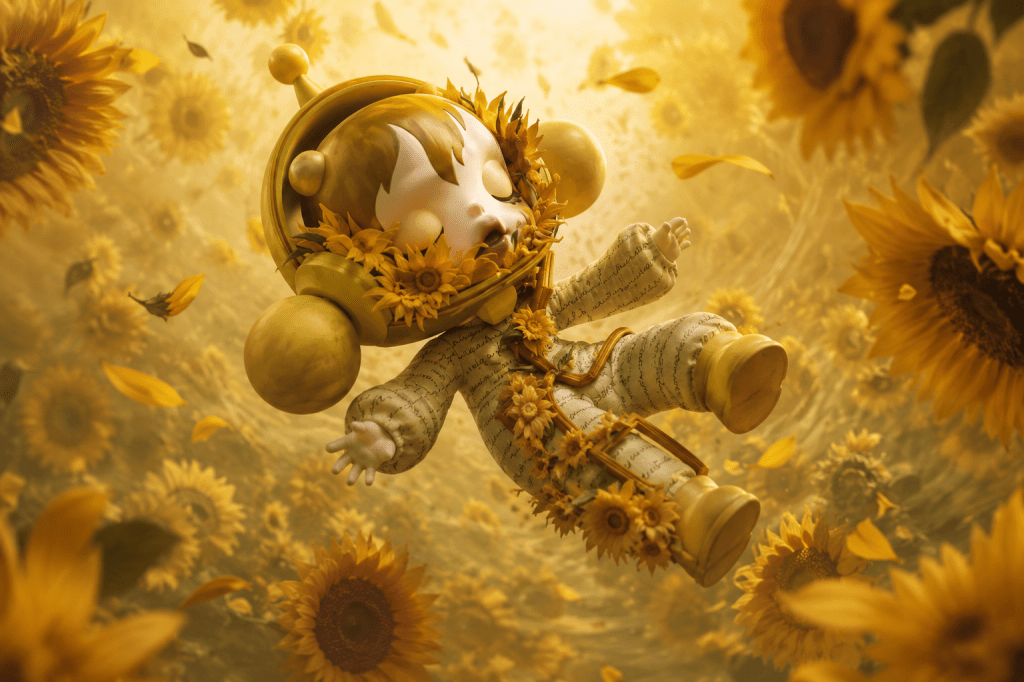
Abstract: By examining the collaboration between Skullpanda and the Van Gogh Museum through the lens of collector culture, museum practice, and cultural value, this essay argues that the project was ultimately positioned as merchandise rather than as a significant artistic dialogue, revealing broader tensions between commerce, curation, and cultural stewardship.
The global art world is currently experiencing what can only be described as an Asian Renaissance. Against this backdrop, the recent collaboration between Chinese artist Skullpanda and the Dutch Van Gogh Museum had the potential to become an iconic artistic, cultural, and strategic moment. Instead, by releasing the Van Gogh × Skullpanda sculpture as a globally available product—without scarcity, curatorial vision, or meaningful positioning within the rapidly expanding Asian art and collector landscape—the project was treated as merchandise rather than as a significant work of cultural collaboration.
In doing so, the museum missed an opportunity to engage thoughtfully with both Van Gogh’s legacy and the growing influence of contemporary Asian visual culture. The result is a release that undervalues the cultural significance of the partnership, overlooks the artistic depth of Skullpanda’s contribution, and raises broader questions about how heritage institutions navigate emerging art forms in an increasingly globalized cultural economy.
This essay explores why the collaboration represents a missed opportunity for the Van Gogh Museum—not merely in commercial terms, but in matters of strategy, curatorial leadership, cultural relevance, and institutional integrity.
Art Toys
Over the past year, I have found myself increasingly drawn into the world of art toys. What began as casual curiosity soon evolved into something deeper: an appreciation for a creative industry that generates billions of dollars globally while simultaneously functioning as a vibrant cultural ecosystem. To outsiders, it is often dismissed as a niche market of collectible figures, driven by hype and social media. But beneath the surface exists a sophisticated visual language, an international collector culture, and a generation of artists exploring identity, emotion, and storytelling through sculptural form.
It was through this world that I discovered Skullpanda who is signed by the Chinese company Pop Mart (known from Labubu).
Among contemporary toy artists, her work stands apart. There is a quiet melancholy to it, an emotional subtlety that resists easy categorization. Her figures feel less like products than characters suspended in a state of reflection. They are intimate, atmospheric, almost literary. Looking at them often feels less like encountering an object than reading a fragment of a story whose ending remains unwritten.
For that reason, I was genuinely excited when I learned that Skullpanda had collaborated with the Van Gogh Museum.
Cultural bridge
The pairing seemed unexpectedly perfect. Here was a contemporary artist known for emotional storytelling entering into dialogue with one of history’s most emotionally expressive painters. More importantly, it felt like a rare cultural bridge: an opportunity for a major European museum to engage seriously with an emerging artistic medium that has become enormously influential among younger generations, particularly in Asia.
When I eventually encountered the collaboration in the Pop Mart store in Amsterdam, I was prepared to buy it immediately.
The piece was beautiful. Thoughtfully designed. Clearly created with care. Then I asked a simple question.
“Is this a limited edition exclusive to the Netherlands?”
The answer was no.
It was being sold globally.
Across Asia. Across multiple markets. Essentially everywhere.
And at that moment, something in me went quiet.
Not because I object to museum merchandise. Museums require revenue, and commercial partnerships are an unavoidable reality of contemporary cultural institutions. Nor was I disappointed because I had hoped to own something rare.
What unsettled me was what that answer seemed to reveal about how the collaboration itself had been conceived.
The more I thought about it, the more it became clear that my disappointment had very little to do with the object itself. In fact, the object remained remarkable. Skullpanda had clearly approached the project with seriousness and care. My discomfort stemmed from something else entirely: the feeling that the museum understood the collaboration fundamentally differently than the artist did.
Consumer culture
The art-toy world occupies a peculiar position between commerce and culture. Like any contemporary creative industry, it relies on manufacturing, distribution, and sales. Yet it also possesses its own systems of meaning, prestige, and artistic legitimacy. Collectors do not merely purchase objects. They participate in narratives. They invest in stories, contexts, communities, and cultural moments.
This distinction matters because the art-toy market effectively operates through two parallel logics.
One is commercial. It prioritizes scale, accessibility, and global distribution. The objective is visibility and revenue. The other is cultural. It prioritizes context, scarcity, and artistic intention. The objective is significance.
Neither model is inherently superior. Both have their place. The problem arises when institutions fail to recognize which model they are operating within.
What struck me about the Skullpanda collaboration was that it seemed to belong naturally to the second category while being distributed according to the first.
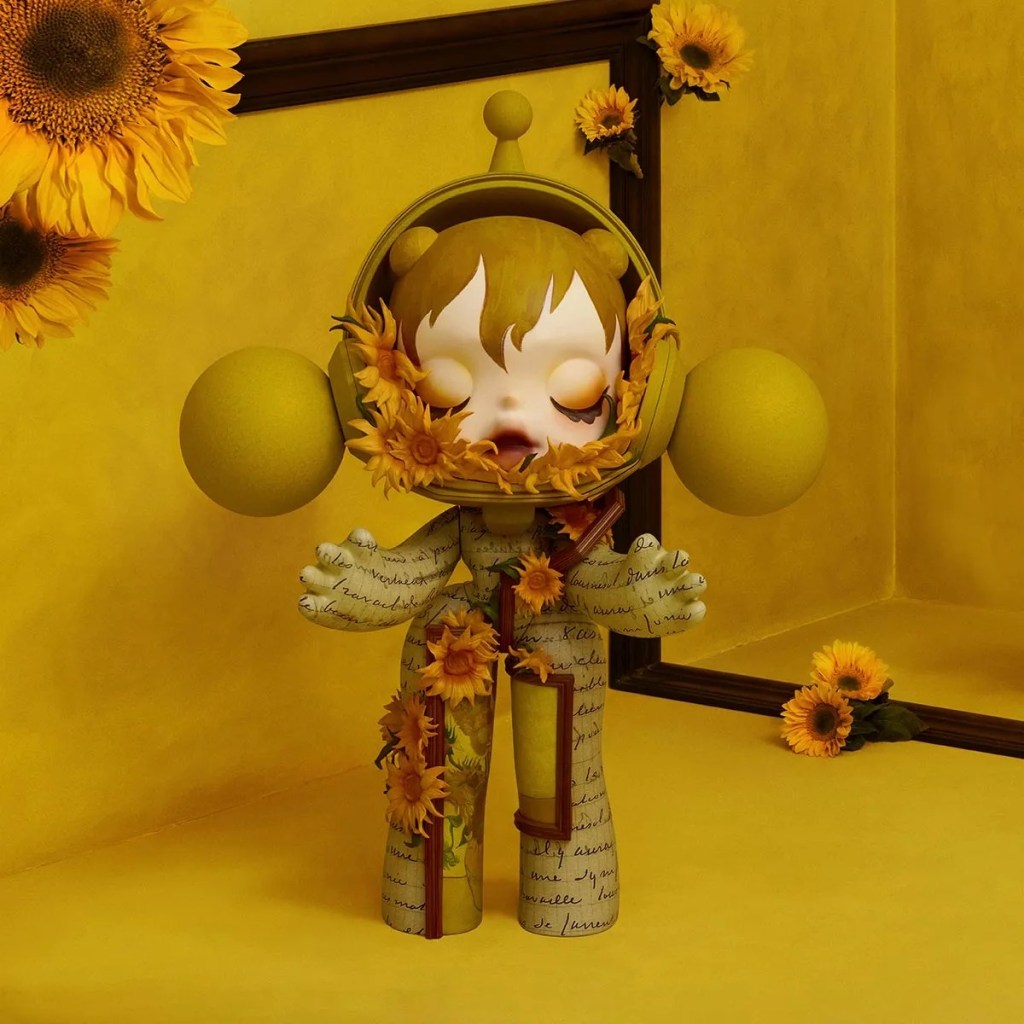
The contradiction becomes even more apparent when one looks closely at the figure itself.
This was not a standard licensing exercise. In many collaborations, an existing sculpt is simply repainted or decorated with imagery borrowed from a famous artist or brand. Here, however, Skullpanda went considerably further. New sculptural elements were introduced. Symbolic references were embedded into the design. Most notably, she incorporated elements connected to Van Gogh’s letters to Theo, shifting attention away from the familiar mythology of the tortured genius and toward the deeply human figure behind it.
The result feels less like a licensed product than an act of interpretation.
Less a collaboration than a tribute.
It is precisely because the artistic effort is so evident that the surrounding institutional decisions feel strangely disproportionate. One side approached the project as a cultural dialogue; the other appeared to treat it primarily as a retail opportunity.
That may sound like a harsh judgment, but it becomes difficult to avoid once one considers what this collaboration might have represented.
Imagine, for a moment, that the release had been available only through the Van Gogh Museum in Amsterdam.
The object itself would not have changed. The sculpt would remain identical. The craftsmanship would remain identical. Yet culturally, everything would have been different.
Collectors from Asia, North America, and across Europe would have travelled specifically to obtain it. Online communities would have documented the journey. The release would have generated attention not through marketing campaigns but through the organic energy that emerges whenever scarcity intersects with cultural meaning.
More importantly, the collaboration would have ceased being a product and become an event.
The distinction may appear subtle, but it is crucial.
Museums are not remembered for the volume of merchandise they sell. They are remembered for the cultural moments they create.
Collaborating in modern times
When people discuss Murakami’s collaborations with Louis Vuitton, KAWS’s relationship with MoMA, or early designer-toy releases connected to Basquiat, they are not discussing retail strategy. They are discussing moments when institutions recognized that culture was changing and chose to engage with that change rather than merely capitalize on it.
The Van Gogh Museum was presented with a similar opportunity.
Not an opportunity to sell a toy.
An opportunity to acknowledge that toy art has matured into a legitimate cultural language.
An opportunity to connect European artistic heritage with contemporary Asian visual culture and collectable art.
An opportunity to demonstrate that stewardship of the past does not require indifference to the future.
Instead, the collaboration was absorbed into the logic of global distribution and commercial scalability. In practical terms, this decision may well have generated additional revenue. Yet cultural value does not always follow the same rules as economic value. Sometimes scarcity creates significance. Sometimes limitation creates meaning. Sometimes saying no to a larger market is precisely what transforms an object into a cultural artifact.
Museum esthics
Ultimately, my objection is not commercial but ethical.
Museums occupy a unique position within society because they are entrusted with something larger than inventory or intellectual property. They are custodians of meaning. Their responsibility is not merely to preserve objects but to preserve contexts, stories, and cultural significance.
Van Gogh himself occupies a particularly complicated place within this discussion. Few artists have been reproduced, licensed, and commercialized as extensively. His paintings appear on mugs, umbrellas, notebooks, tote bags, and countless other products. One more collaboration is unlikely to alter that reality.
Yet there remains an important difference between using an artist’s imagery and engaging with an artist’s legacy.
The former produces merchandise.
The latter produces culture.
What makes the Skullpanda collaboration so fascinating is that it briefly seemed capable of doing the second. For a moment, it suggested the possibility of a genuine conversation between historical and contemporary art, between European institutions and Asian collector culture, between established definitions of artistic legitimacy and emerging ones.
That possibility is what I felt slipping away when I received that answer in the Pop Mart store.
The disappointment was never really about exclusivity.
It was about recognition.
Recognition that toy art has evolved beyond merchandise.
Recognition that collector culture can carry genuine cultural meaning.
Recognition that a van Gogh collaboration can be more than a product.
Most of all, it was about the missed opportunity to treat a historic meeting between two artistic worlds as a cultural event rather than a commercial release.
Because art does not merely reflect the world. It shapes the way we understand it.
And institutions entrusted with preserving cultural heritage should be among the first to recognize when new forms of culture are asking to be taken seriously.
 the Correspondette