
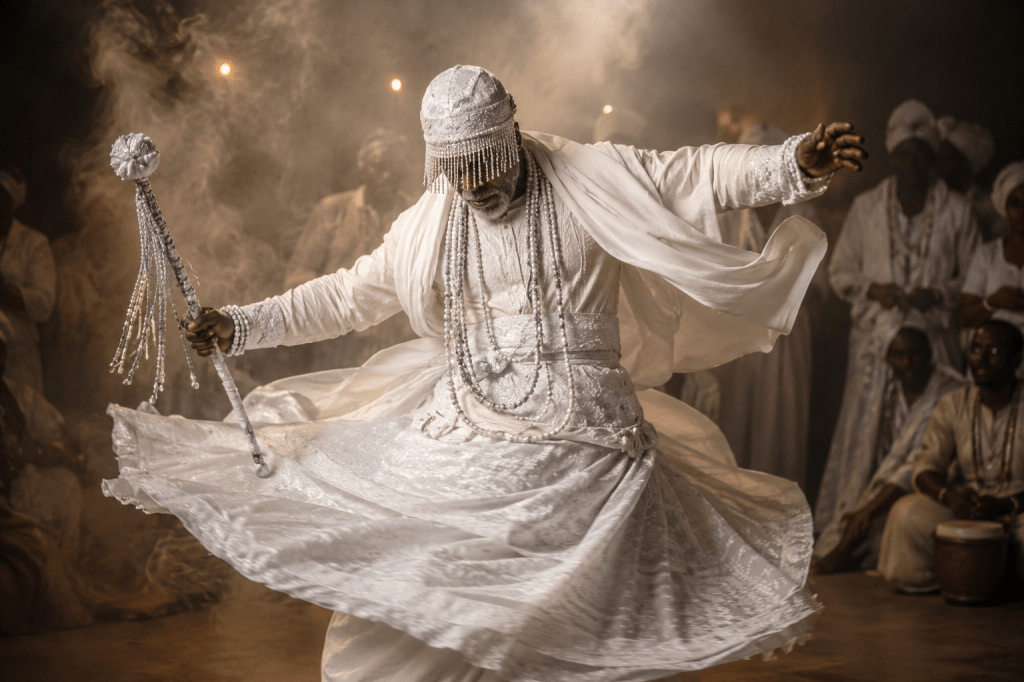
Abstract: Through the global circulation of Cuban Salsa and other Afro-diasporic dance traditions, the Yoruba deity Obatalá continues to reach new audiences. This essay explores how dancers embody a form of authority grounded not in force or spectacle, but in presence alone.
—
The Yoruba are one of West Africa’s largest ethnic groups, known for a rich cultural heritage shaped by philosophy, artistic expression, ancestral reverence, and oral tradition. Through the African diaspora, their stories, rituals, music, and dances spread across the Caribbean and the Americas. Orisha are divine beings in the Yoruba tradition, associated with different aspects of nature, morality, and human experience. They serve as intermediaries between humanity and the divine, embodying forces such as wisdom, creation, love, justice, storms, rivers, and change. Through the global circulation of Afro-diasporic dance forms, Orisha continue to be interpreted through contemporary dance, choreography, and performance, reaching increasingly diverse audiences in the West. Orisha may be represented in art through natural forces, human-like forms dressed in traditional attire, or, in Afro-diasporic traditions such as Santería, through Christian iconography. Orisha Obatalá, for example, is commonly associated with Our Lady of Mercy (Nuestra Señora de las Mercedes).
The embodiment of Obatalá is difficult to summarize without reducing his complexity. He is often portrayed as an elderly figure dressed entirely in white, the color of purity, wisdom, and clarity. His body appears bent, slow, or physically burdened. His gaze is frequently directed toward the earth. He is commonly depicted carrying a ceremonial staff or scepter and is associated with gestures of self-discipline and care. Within Yoruba cosmology, Obatalá is one of the highest-ranking Orisha, positioned directly beneath Olódùmarè, the supreme creator and source of existence. His role is not that of a ruler in a political sense, but of a moral and structural anchor within the Yaruba pantheon. Obatalá embodies order, ethical responsibility, and legitimacy, while other Orisha operate within the boundaries he establishes.
Obatalá as a mirror
My fascination with Obatalá did not emerge from theoretical knowledge, but from an artistic encounter. During a salsa concert, I watched several Orisha being portrayed on stage by performers. It seemed to me that the movements of Orisha Yemanjá, Shango, and Oyá were choreographically expressive and technically spectacular (see video below). Yet Obatalá, all dressed in white, captured my attention the most. Honestly, he creeped me out! While I was looking at the performer it made me wonder: why am I drawn to the slowest, least spectacular figure on the stage? And why does he seem so respected by the other Orisha?
Many of the dancers around me seemed less enthralled by Obatalá. One dancer told me that his music made her feel sad and that his energy felt “off.” She preferred the dynamism of figures such as Orisha Oyá, whose movements are faster, more expressive, and immediately engaging. This reaction is revealing. It suggests that we often associate powerful performance with excitement, intensity, and emotional uplift. Obatalá offers none of these things. Instead, he seemed to demand patience. His movements unfold slowly, his presence lingers, and his authority seems to reveal itself gradually rather than all at once. What initially appears subdued may therefore challenge not only our expectations of dance, but also our assumptions about how power itself should be recognized. I mean, he IS theologically the highest-ranking Orisha. It is precisely in this context that Obatalá becomes a mirror through which we can examine our own assumptions about the esthethics of authority and legitimate power.
Representation of power
In many Western artistic traditions, legitimate power is often represented as something loud, visible, and expansive. From the heroic bodies of Classical sculpture and Renaissance rulers on horseback to military monuments, political imagery, and contemporary action cinema, authority is often associated with physical dominance, visibility, and control. Similarly, in dance, authority frequently appears as something that must continually assert and prove itself. These representations reflect broader cultural assumptions in which power is expected to announce itself through action, force and spectacle. The more attention a figure commands, the more powerful it is perceived to be.
My experience during the concert suggests that many might have been conditioned to associate powerful performance with these conventional markers of authority. As a result, a slow figure like Obatalá can initially appear boring, sad, uncomfortable, or even “off.” He is a figure who seems least interested in entertaining the audience. Obatalá invites us to reconsider our cultural and aesthetic assumptions about what power should look and feel like. What initially appears subdued may therefore challenge not only our expectations of dance, but also our assumptions about how power itself should be recognized within the arts.
Obatalá’s Dance
As the creator of the human form and protector of the head (ori), the center of consciousness and moral guidance, Obatalá occupies a unique position within Yoruba cosmology as the creator of mankind. The difficulty many dancers have in recognizing Obatalá’s physical authority reveals how deeply contemporary aesthetic cultures have come to associate power with visibility, intensity, and spectacle. Obatalá challenges these assumptions by presenting a form of legitimacy that derives its authority from restraint, patience, and ethical responsibility rather than performance itself. For that reason, dancing Obatalá is not simply the embodiment of an elderly man. It is the embodiment of a different value system. Why is this often not recognized, even with dancers? I think there are several reasons, and they connect directly to my argument.
- There is power in restraint
Dancers are not immune to the cultures in which they perform. They are constantly encouraged to move bigger, faster, and with greater display. Over time, these expectations shape how legitimacy and power is understood on stage. As a result, both audiences and performers often come to associate strength with expansion and visibility, while overlooking the quiet discipline required to hold back. Restraint, however, demands its own kind of power: the ability to remain measured, controlled, and deliberate even when there is pressure to do more.
Obatalá offers the opposite. His body evokes old age, physical limitation, heaviness, and responsibility rather than youthful vitality or heroic strength. He enters the stage not as a spectacle, but as a cripple, burdened presence. His authority does not emerge from what his body can do, but from what it carries. That is a difficult thing to do convincingly, which is precisely why it can be so powerful when done well. It is movement without glamour: a form of authority that is rarely recognized or desired in Western contexts, where old age, and physical disability and responsibility are seldom considered sources of legitimate power.
2. Power moves slowly
Second, Obatalá demands a different kind of attention. His dance unfolds slowly. It asks the audience to wait. It asks the dancer to resist the urge to impress with speed. In a culture shaped by constant stimulation and immediate gratification, slowness is often mistaken for emptiness. What takes time to reveal itself can easily be overlooked.
To occupy space in this manner as a dancer requires courage. It requires a performer to temporarily abandon many of the qualities that are usually rewarded on stage: virtuosity, athleticism, flexibility, charisma and acrobatics to name a few. In other words, the dancer voluntarily gives up many of the tools normally used to impress an audience and enters the stage slowly. The dancer must resist the temptation to entertain others and instead cultivate a presence that assumes that people are looking. To perform him convincingly, you have to let go of the need to impress and trust that presence is enough. In that sense, portraying Obatalá is almost an artistic statement.
3. Relational authority
Third reason why Obatalá’s legitimate stage presence might be overlooked is that his authority seems to be relational rather than demonstrative. He rarely proves his power through physical confrontation. Instead, his status becomes visible through how others respond to him. Eleguá bows. Other Orisha make space. He doesn’t look at the audience. He doesn’t dominate. His authority is already assumed. For viewers accustomed to seeing power displayed through action and force, this subtle cue can be difficult to recognise.
An alternative understanding of power becomes visible through several interconnected choreographic qualities: a body that challenges conventional expectations of strength and visibility, a form of legitimacy that operates without spectacle, an embrace of physical ambiguity, his authority that is relational, and a sustained emphasis on restrained. Together, these elements reveal a conception of power and legitimacy rooted less in commanding others than in mastering oneself.
1. The Body as Counterimage
In Afro-diasporic dance traditions, Obatalá is most often represented as an elderly figure clothed entirely in white. His movements are measured and deliberate, his gaze lowered toward the earth, and his presence conveys a profound sense of gravity.
His physical appearance is ambivalent: bent, sometimes fragile, yet unpredictable. That unpredictability makes his presence uncomfortable. Not because he is weak, but because his power is not immediately recognizable to us. This is dominance without glamour: a form of authority that is rarely recognized or desired in Western contexts, where old age, and physical disability are seldom considered sources of power.
Rather than attracting attention through dramatic movement or theatrical display, he establishes authority through stillness, composure, and consistency. His power is not asserted; it is recognized and others adjust themselves in relation to it. Obatalá’s dance presents a distinct model of authority, one that emerges through restraint rather than display.
Obatalá refuses to embody aesthetic pleasure according to conventional standards. His body evokes associations with old age, disability, heaviness, and moral burden. He does not embody youthful energy or heroism, but a form of power that emerges from survival and wisdom. To occupy space in this manner as a dancer requires courage. A great deal of courage.
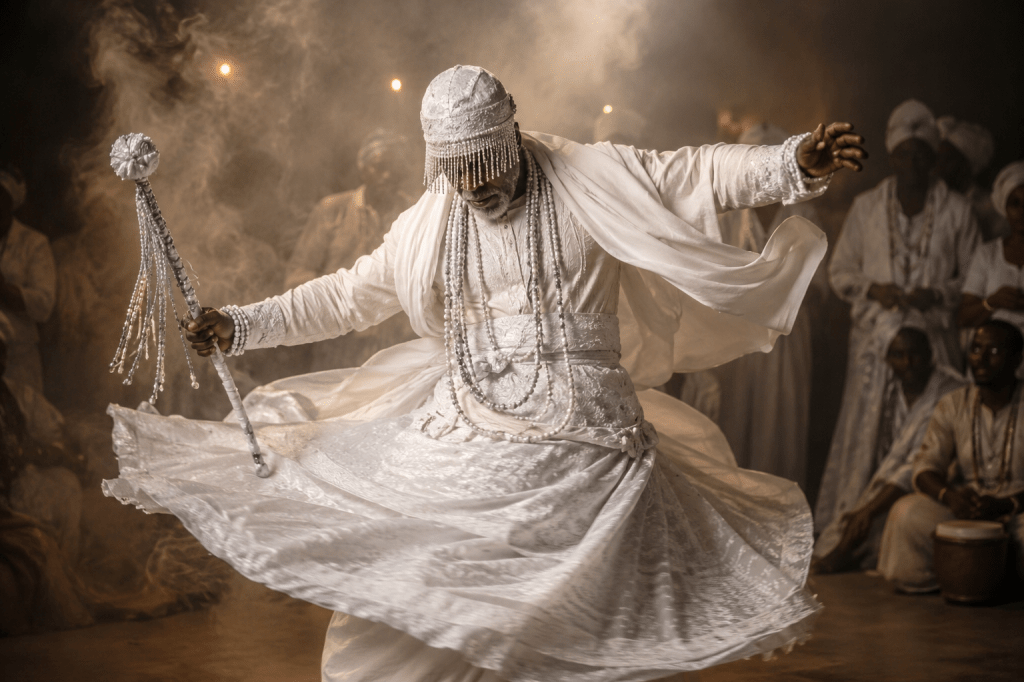
It is a presence that is not “beautiful” in the conventional sense, and it is precisely for that reason that it becomes confrontational. His dance resists a gaze that equates strength with speed, smoothness, and control. It’s bold because portraying Obatalá requires a dancer to temporarily abandon many of the qualities that are usually rewarded on stage. In other words, the dancer voluntarily gives up many of the tools normally used to impress an audience.
Read through the lens of power, Obatalá’s dance offers a striking alternative to dominant Western understandings of authority. It suggests that legitimacy does not necessarily arise from visibility, domination, or performance, but can emerge through patience, responsibility, and ethical restraint.
In Obatalá’s movements, authority appears not as violence or bravado, but as unpolished presence. Not as spectacle, but as deliberate movement with a long breath. His actions take time, demand attention, and reorganize the space in which they appear. He changes not only the rhythm of the music—he possesses his own claves—but also the pace at which others relate to him.
2. Legitimacy Without Spectacle
You could even argue that portraying Obatalá is bold because it goes against what performance itself often demands. Performance usually seeks visibility; Obatalá lowers his gaze. Performance seeks excitement; Obatalá asks for patience. Performance often rewards spectacle; Obatalá derives authority from the refusal of spectacle.
For that reason, dancing Obatalá is not simply the embodiment of an elderly man. It is the embodiment of a different value system. The dancer must resist the temptation to entertain and instead cultivate a presence that commands respect without asking for it. That is a difficult thing to do convincingly, which is precisely why it can be so powerful when done well.
When Obatalá appears, he does not claim space through speed or volume, but through duration and announcement. He takes his time—truly—and demands patience from those around him. The music accompanying him is heavy and carrying. It marks the arrival of an authority that has no intention of yielding.
The manifestation of Obatalá as an elderly man in dance raises fundamental questions about leadership, authority, and ethics. Rather than commanding attention through dramatic gestures, he moves slowly, keeps his gaze fixed on the ground, and allows his presence to speak for itself.
His physical appearance is ambivalent: bent, sometimes fragile, yet unpredictable. That unpredictability makes his presence uncomfortable. Not because he is weak, but because his power is not immediately recognizable to us. This is dominance without glamour: a form of authority that is rarely recognized or desired in Western contexts, where old age, ethics, and physical limitation are seldom considered sources of power.
This makes his dance extraordinarily artistic and radical within Western aesthetic frameworks. His authority does not need to prove itself; it simply exists, and others adjust themselves in relation to it. Read through the lens of legitimacy, his dance offers a striking alternative to dominant understandings of authority—one rooted not in force, spectacle, or domination, but in restraint, responsibility, and moral consciousness.
3. Physical Ambiguity
In Yoruba and Afro-Cuban traditions, Obatalá is not always understood or portrayed as a single, fixed personality. Instead, he can appear through different avatars, roads, manifestations, or caminos (Spanish for “paths”). In Santería/Lukumí, people often speak of the caminos de Obatalá—the different ways Obatalá manifests himself – old and young, male and female – but in all of them he embodies an authority that does not need to prove itself, though it can assume power when necessary. Visually, he is typically dressed in white, the color of purity, wisdom, and clarity. His body is often portrayed as old, bent, slow, or even physically impaired, yet capable of becoming unexpectedly sharp and decisive. He is commonly depicted carrying a ceremonial staff or scepter, while some dance traditions emphasize gestures of self-correction and discipline, occasionally represented through a switch or whip.

Different manifestations of Obatalá are traditionally represented through distinct garments, colors, accessories, and ceremonial styles, each reflecting a particular aspect of his character. This essay focuses on an older manifestation frequently portrayed in Afro-diasporic dance traditions: a figure dressed entirely in white, whose age, wisdom, and moral authority shape the choreography. In this embodiment, authority does not derive from violence, physical appearance, or youth, making the body a site through which an alternative understanding of power is expressed.
Legitimacy does not need to prove itself. It is slow, takes up space, and proceeds from the self-evident assumption that others will relate themselves to it. In dance, power determines the rhythm of space; the audience adapts. In that sense, power is not necessarily harmonious or beautiful. It is fundamentally uncontrollable and can be both vulnerable and overwhelming when balance must be restored.
Obatalá embodies a form of authority that we barely see in the West. It does not need to prove itself, yet remains responsible. A power that restrains itself, that appears vulnerable yet remains potentially decisive. Obatalá’s presence reveals that authority does not necessarily reside in speed, strength, youth or spectacle, but sometimes precisely in slowness, age, care, and moral weight.
Obatalá embodies precisely this tension. He moves low and dragging, yet can suddenly accelerate when necessary. He can shift form—young, old, feminine—and cannot be fixed into a single identity or role. This physical ambiguity strengthens his authority: he remains elusive.
4. Dramaturgy and fixed Choreography
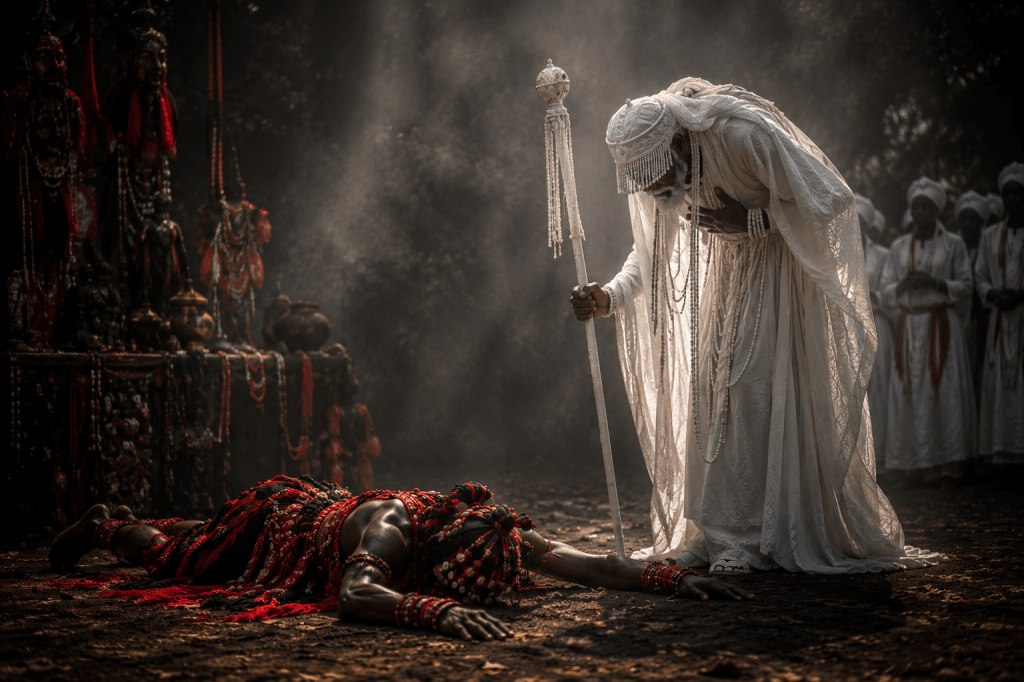
In choreographic dramaturgy, Obatalá often appears after Eleguá, the Orisha of chaos and transition. Where Obatalá represents order, Eleguá represents contingency. He embodies the uncertainty that makes freedom, choice, and transformation possible. When Obatalá enters, Eleguá literally submits by lying flat on the ground before him. Obatalá does not need to confront Eleguá; his presence is sufficient.
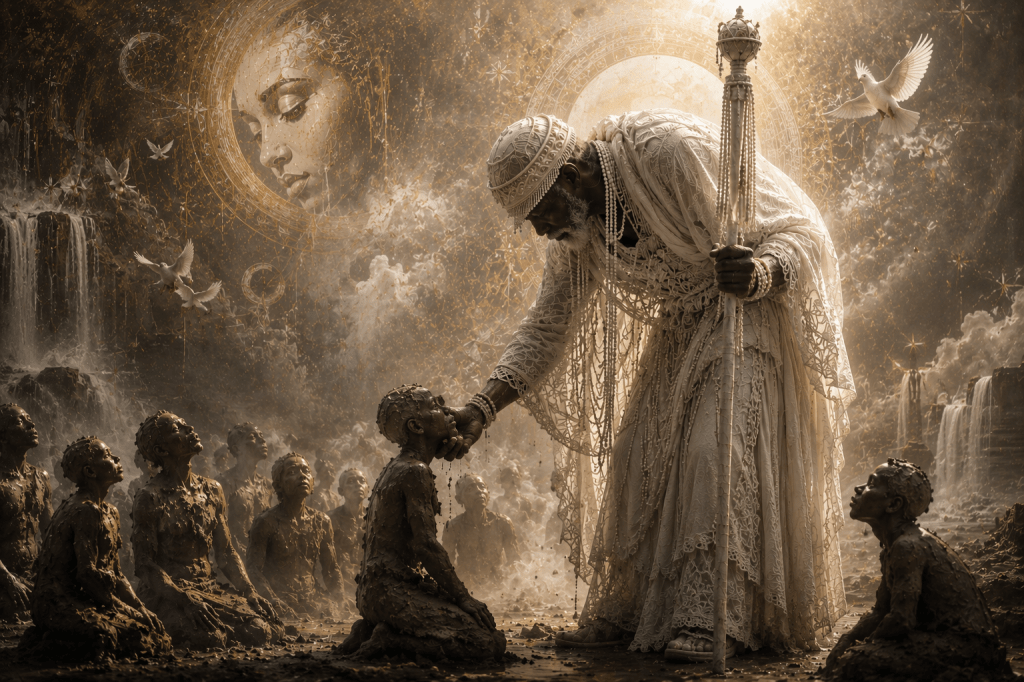
Cosmologically, Obatalá represents the principle that creation entails responsibility. As the shaper of human beings and guardian of the ori, he embodies a form of authority rooted in care, restraint, and moral order rather than domination. Touching the earth, he performs a gesture of care toward the humanity he shaped from clay. In both myth and movement, Obatalá embodies a form of power that is reflective, restrained, and deeply rooted in responsibility.
His gaze remains directed toward the earth, the place where he molds human beings from clay. His power lies not in domination, but in formation. This becomes visible in the kneading movements of his hands: intense, controlled, and precise. A power that does not confront, but shapes. Unlike Orisha associated with fire, iron, water, or chaos, his authority is based on his responsibility. An essential aspect of Obatalá’s role is his protection of those who are most vulnerable: people with physical or mental disabilities, the elderly, children, and anyone who falls outside dominant norms of functionality and speed. In many Yoruba and Afro-diasporic traditions, he is explicitly regarded as the protector of people with disabilities. This is not a marginal detail, but a central aspect of his meaning and his dance. According to various myths, Obatalá makes mistakes while creating humanity from clay. Rather than denying these mistakes, he takes responsibility for them. Vulnerability appears here not as a deviation, but as a constitutive element of being human. The implicit message is radical: vulnerability is not a flaw in the system—vulnerability is the system. Obatalá protects what he himself has created, especially when it does not conform to dominant ideas of strength, beauty, or perfection. His power lies not in flawlessness, but in care and accountability. He loves the underdog so to say and loves to take care of them.
5. Discipline as the Highest Form of Power
A crucial element in Obatalá’s performance is his self-discipline. With his whip, he corrects himself (although this interpretation is not factual within the tradition) and reminds himself of his own imperfection. This is not masochism, but a radical ethical position: power directed inward before it is directed outward. He actively and consciously restrains his own actions and power.
It is precisely because of this that Obatalá can function as an ethical infrastructure within Yoruba cosmology. Where other Orisha are excessive—embodiments of fire, conflict, temptation, or chaos—he forms the exception. He is the measure against which their actions acquire meaning.
By observing how Obatalá moves, how he occupies space, and how other figures respond to him, it becomes clear that authority in dance does not necessarily have to be enforced. His dominant position exists without the need for proof, without ornamentation, and gains legitimacy precisely because of this. Authority appears here not as performance, but as condition. If you look and see nothing, you simply look harder.
Limits of recognition
Why is this often not recognized, even with dancers? I think there are several reasons, and they connect directly to my argument.
First, dancers are not immune to the culture they live in. Even highly trained dancers are constantly rewarded for qualities such as virtuosity, athleticism, speed, flexibility, extension, charisma, and stage presence. Those values become internalized. As a result, many dancers unconsciously learn to recognize power when it appears as expansion rather than restraint.
Second, Obatalá demands a different kind of attention. His dance unfolds slowly. It asks the audience to wait. It asks the dancer to resist the urge to impress. In a culture shaped by constant stimulation and immediate gratification, slowness is often mistaken for emptiness. What takes time to reveal itself can easily be overlooked.
Third, Obatalá’s authority is relational rather than demonstrative. He rarely proves his power through confrontation. Instead, his status becomes visible through how others respond to him. Eleguá bows. Other Orisha make space. The authority is already assumed. For viewers accustomed to seeing power displayed through action, this can be difficult to recognize.
There is also an aesthetic dimension. In many Western traditions, beauty and power are often linked to youth, vitality, symmetry, and physical capability. Many people spend their whole lives chasing those things.
Obatalá’s elderly body, occasional association with disability, and deliberate movements disrupt these expectations. His authority emerges precisely through qualities that dominant visual cultures tend to marginalize. He represents a form of power that does not depend on being admired. There is something liberating about that.
What I find most interesting is that this misunderstanding may actually confirm the point of the dance itself. If audiences—and even dancers—initially overlook Obatalá, it reveals how deeply many of us have been conditioned to equate power with visibility and spectacle. The dance exposes not a weakness in Obatalá, but a limitation in our own expectations.
That insight could almost become a thesis sentence in this essay:
The difficulty many dancers have in recognizing Obatalá’s authority reveals how deeply contemporary aesthetic cultures have come to associate power with visibility, intensity, and spectacle. Obatalá challenges these assumptions by presenting a form of authority that derives its legitimacy from restraint, patience, and ethical responsibility rather than performance itself. I think you’re interested in Obatalá because he challenges a hierarchy that you already seem suspicious of: the idea that visibility equals value.
Conclusion
His dance is unpredictable, layered, and deliberate. Every movement is a conscious choice, fully devoted to that which he creates and the responsibility he takes. It is precisely for this reason that Obatalá remains elusive and relevant. This form of power is rare – in mythology, in art, and in everyday life – and therefore resonates deeply. Power moves slowly, authority is relational al legitimacy can suddenly accelerate and shift forms.
The dancer who dares to surrender to this aesthetic must take time, must slow down, must resist expectations of effect and speed. Also, the performer must trust that people will look at him while he is taking his time to make an entrance. His complexity and counterintuitive dance movements, his authority and vulnerability, his different manifestations and presence all make him one of the most powerful Orisha, and he knows it. And although he could be at peace with this burden, he keeps himself restrained and humble.
That is what makes the dance of Obatalá not only fascinating, but fundamentally worthy of respect. Its power is not immediately visible. It unfolds gradually, revealing itself only to those willing to slow down and pay attention. In this sense, Obatalá’s dance challenges the viewer as much as it challenges the performer. A line from Shōgun comes to mind, when Lady Kiku remarks: “If you look and see nothing, you simply look harder.” Perhaps the same can be said of Obatalá. His authority is not hidden; it simply demands a different way of seeing.
 the Correspondette
Leave a comment